Germany's Heat Problem Was Not a Surprise
A DWD station-data analysis of German summer heat, hot nights, and heatwaves since 1951, and why heat adaptation should have been treated as infrastructure.
Every time Germany gets hit by a serious heatwave, the country seems to rediscover the same basic facts. Apartments overheat. Hospitals and care homes struggle. Rail, roads, schools, offices, and outdoor work all become less reliable. The public debate then falls into a familiar argument: maybe Germany was never built for this because Germany used to have mild summers.
There is truth in that. German summers were milder in important statistical senses. The hottest daytime temperatures were lower. Tropical nights were less common. The upper tail of the temperature distribution has clearly shifted. Climate change is not a branding exercise here; it shows up in the measurements.
But the convenient version of the story is also too forgiving. Germany did not go from “no heat problem” to “heat problem” overnight. The official German and European language around heat now treats it as a recurring public-health risk. The European Environment Agency says heat is the deadliest weather- and climate-related extreme in Europe. Germany’s health ministry has treated heat protection as a standing health issue, not a one-off weather alert. The hospital and care sectors are increasingly explicit that warnings and brochures are not enough when buildings themselves cannot stay safe.
That is the tension this article is about. If heat was impossible to predict, then poor preparation would be understandable. If it was a foreseeable risk that became steadily more serious, then the policy failure is harder to excuse.
The short version is this: the DWD station data says modern German heat is worse, especially for daytime extremes and post-2000 hot-day-plus-hot-night heatwaves. It also says dangerous heat was not absent before. The infrastructure conclusion is not “Germany should have known today’s exact heatwave.” It is “Germany should have known heat resilience was becoming essential.”
The Debate Has Already Moved
German institutions are no longer debating whether heat deserves public-health attention. The Federal Health Ministry has called heat protection a “Dauerproblem.” The European Environment Agency says heat causes Europe’s largest death toll among weather- and climate-related extremes. Germany’s 2024 adaptation strategy turns climate adaptation into measurable goals across health, care, infrastructure, urban development, and civil protection. RKI estimates thousands of heat-related deaths in recent German summers. European institutions say the same thing at continental scale: Europe is warming quickly, heat-stress days are increasing, and heat-health action plans are now a normal part of climate adaptation.
The political fight is therefore not really about whether heat exists. It is about what kind of response counts as serious. German heat policy often emphasizes warning systems, public information, municipal plans, shading, greening, and protection of vulnerable groups. Those things matter. But hospitals, care homes, top-floor apartments, schools, and poorly ventilated buildings raise a harder question: what happens when passive measures are not enough?
The hospital sector has started saying this out loud. The Deutsche Krankenhausgesellschaft has called for major investment in climate-resilient hospitals. Care-sector guidance discusses indoor room temperatures, not just outdoor forecasts. Green politicians have put the missing-equipment problem bluntly: “Es fehlt an Klimaanlagen.” A 2025 federal answer on hospital heat protection, meanwhile, leaned on the divided responsibility of facility owners and German states. That may be administratively true. It is not reassuring.
A heat policy that cannot keep vulnerable people indoors at survivable temperatures is not yet a heat policy. It is a warning system with paperwork.
What I Measured
The empirical question is narrower than the political argument: how different are German summers now from the relevant past?
For this version of the analysis, I use direct DWD daily climate station observations, not a gridded interpolation. That matters because the “where did this happen?” question is central to the heat debate. Stations are not perfect either. They can move, instrumentation can change, and local siting matters. But they are concrete measurements at known locations, and they let us test whether the old “milder summers” claim survives contact with daily observations.
The data and definitions are:
- Primary source: DWD daily climate station observations.
- Panel: 193 long-running stations with at least 90% coverage across the comparison periods.
- Variables: daily maximum temperature (
Tmax), daily minimum temperature (Tmin), daily mean temperature (Tmean). - Periods: 1951-1960 through 2011-2020, plus 2021-2025 as a five-year recent period.
- 2026: included only as partial current context through June 29, 2026.
- Main heatwave definition: same station, at least 3 consecutive days
with
Tmax >= 30 CandTmin >= 20 C. - Intensity: cumulative excess heat above the selected Tmax and Tmin thresholds, measured in C-days.
The distinction between daily maximum and daily minimum temperature is important. Daytime heat makes outside work, transport, surfaces, and electricity demand more dangerous. Nighttime heat decides whether buildings and bodies get to recover. A country can tolerate some hot afternoons if nights cool down. It has a different problem when hot days are followed by tropical nights.
Daytime Extremes Really Did Move Up
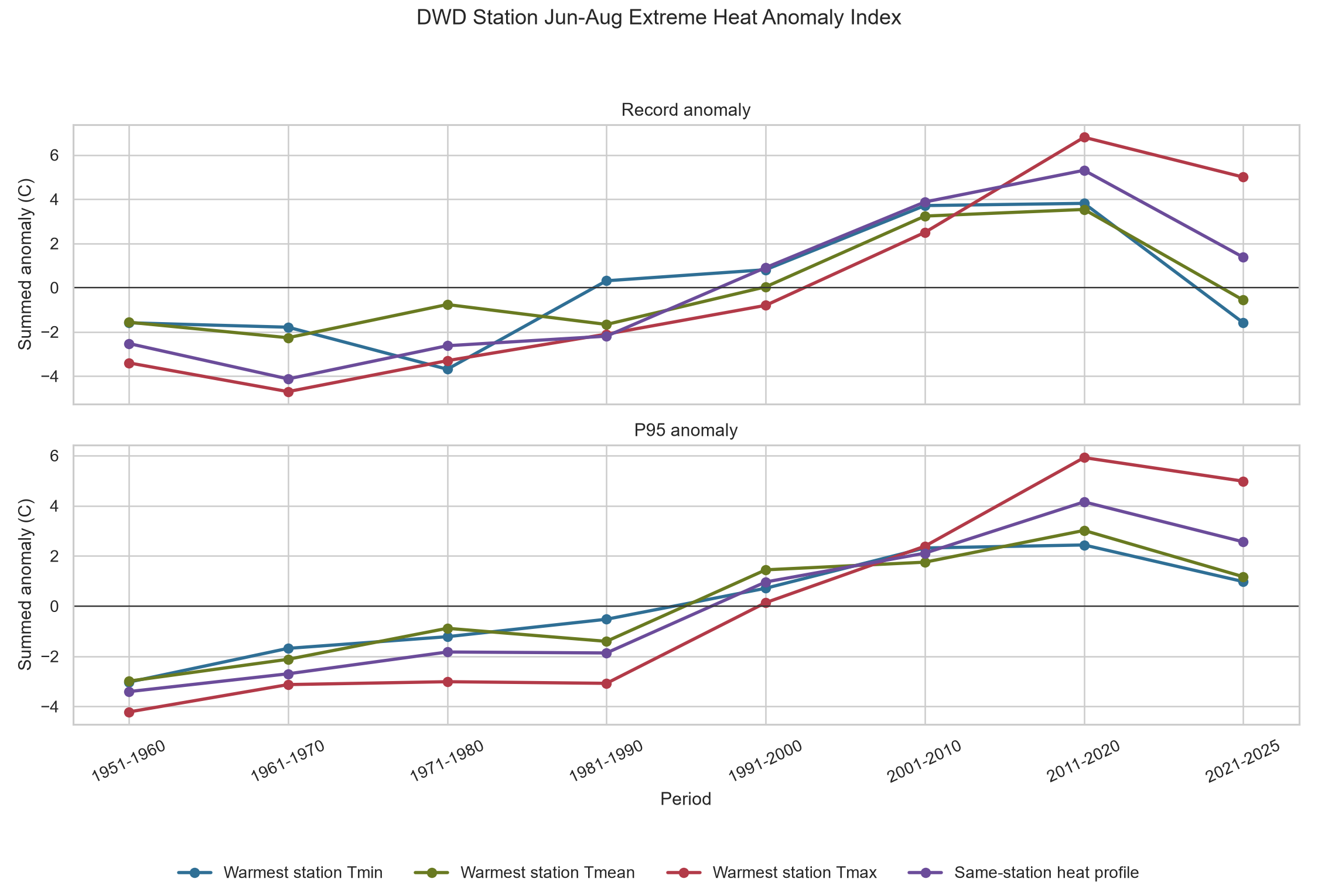
The clearest result is daytime maximum temperature. The record and P95 anomaly series for summer months move from clearly negative in earlier decades to clearly positive after 2000. This is not just one freak record. The high end of the daily Tmax distribution shifted upward.